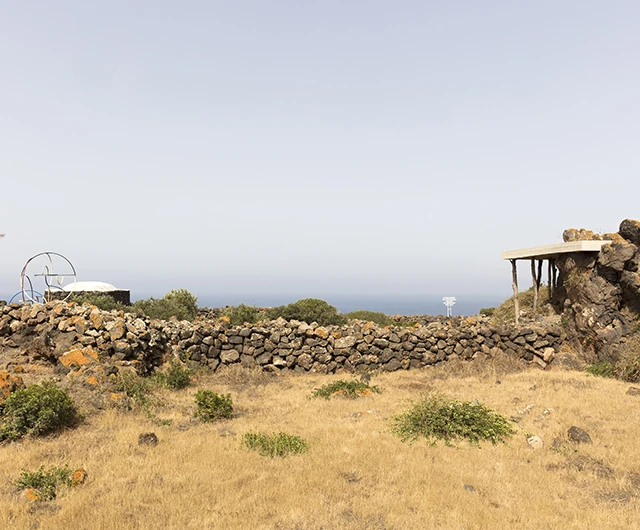
The idea of the primordial shelter continued to play a role in Födinger’s artistic production. A work similar to the one at La Vallée was built on the island of Pantelleria,
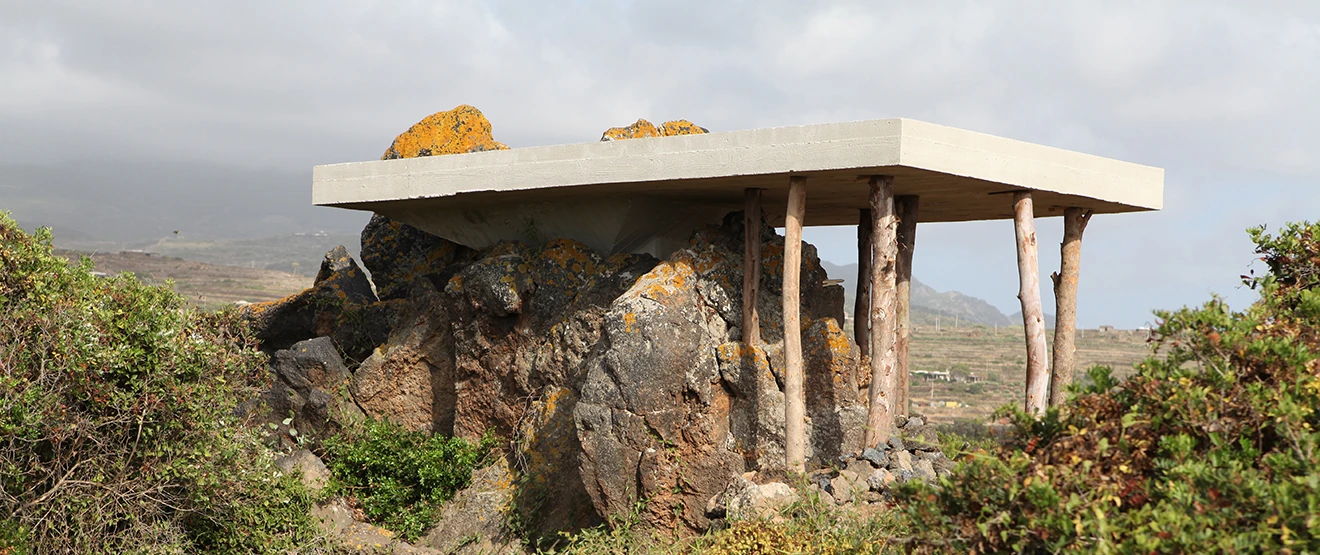
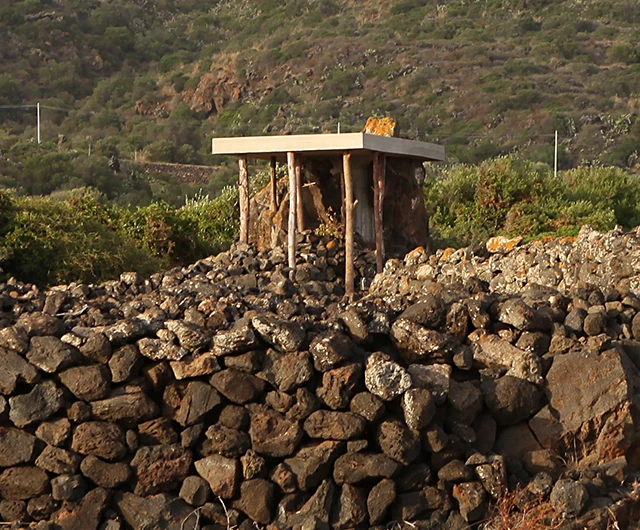
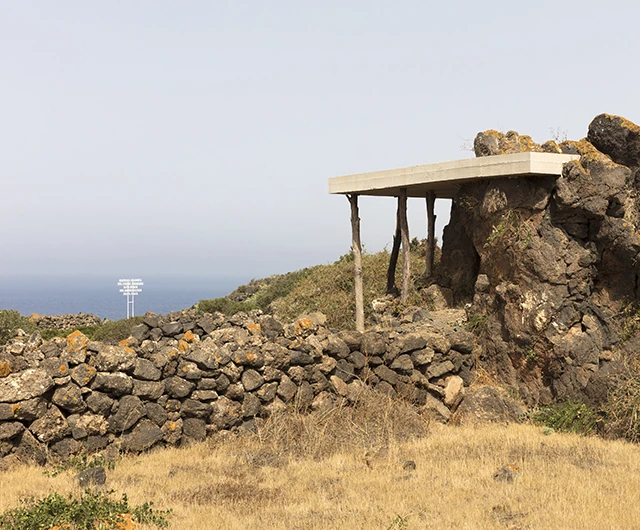
set astride a terracing wall of volcanic rock and given an old Arabic name for the island, Bint al-aryāh (“Daughter of the Wind”), as its title. The work was created in 2015
in the middle of fields in the Cimillia district, on the grounds of the vacation home of an art collector from Biella, Attilio Rappa, called La Collina di Loredana in memory
of his deceased wife.
In the first sketches, dating from the summer of 2013, we find: wooden watchtowers, backing onto the boundary wall and resembling the ones that could once be seen along the
Berlin Wall (Balkons); a cast of concrete in the shape of a fountain to provide water for birds migrating between Africa and Europe, an allusion to other migrants (Vogeltränke,
or Birdbath); a column of steel mesh with concrete poured over it without formwork, in homage to the unfinished state of various building sites on Pantelleria (Säule, or Column);
and even an opening in the surrounding wall, supported by a steel girder and unrecognizable as a work of art (Durchbruch, or Breakthrough).
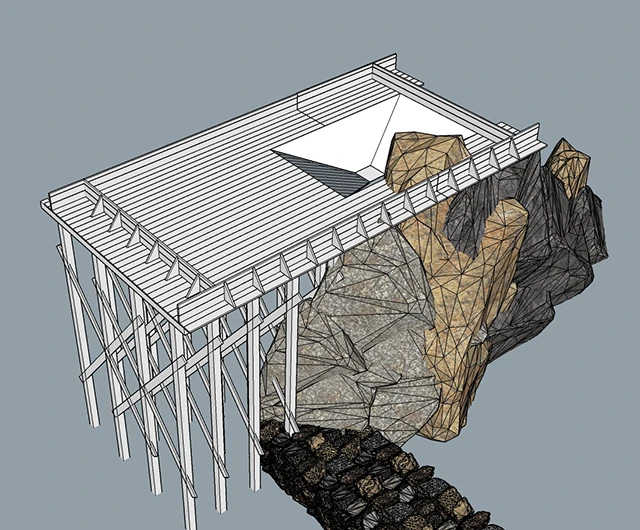
At the beginning of 2014, Födinger considered the possibility of building a platform or a tower out of perfectly finished reinforced concrete, anchored to a mass of volcanic rocks
and no longer placed against the boundary wall. But it was only when the platform at La Vallée made its appearance in the process of creating the work for Pantelleria that it started
to turn into an original variation on that metaphorical combination of concrete and trees. The platform then became a structure of rough reinforced concrete poured into formwork
made from wooden planks and set on top of the volcanic rocks, with the overhang facing the sea supported by vertical and inclined pillars made of the same rough reinforced concrete.
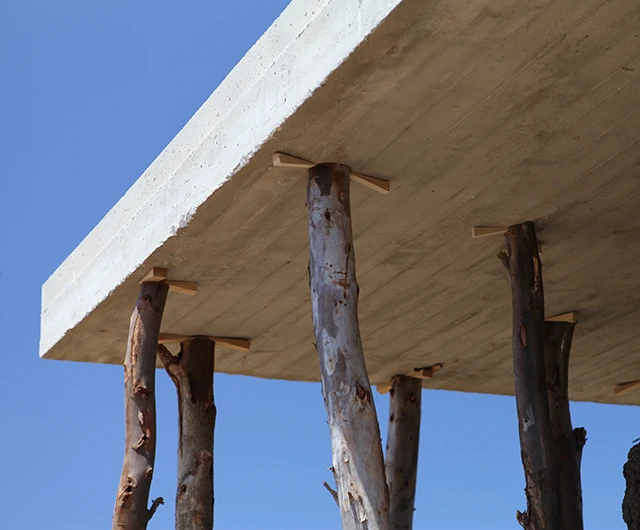
The platform turned into an archaic structure when Födinger took as a model for the supports the slender tree trunks he had seen in a photograph of a building site in India, where
they were used as scaffolding during the construction of a floor slab. Thus the reinforced concrete pillars of the platform on Pantelleria were transformed into rudimentary
tree trunks, with the consequent modification, carried out in the summer of 2014, of the anchorage to the rocks, which became a sort of massive layered mushroom capital or inverted
pyramid (the project was classified under the name Felsen Platte, “rock plate”). The platform, in some sketches, takes on the shape of an ovoid mass made up of several layers, as if
it were a concretion of lava, supported by the rock and the trunks.
In the versions with a rectangular platform, a jag of volcanic rock sticks out of the concrete structure, continuing the play of contrasting geometries and materials that characterizes
the work. But it should be noted that while on the Indian construction site the trunks formed a temporary support for the casting of the slab, as in the case of the scaffolding for
Cantilever, in the project for Pantelleria those same trunks become the permanent supports of the slab.
The arrangement and apparent frailty of the thin trunks produces an effect of precariousness and the sense of an imperiled balance, as in the photographs of the terraces of Wright’s
Fallingwater under construction, or in the overhanging boxes, shored up in precarious fashion, of Koolhaas’s Villa dall’Ava.
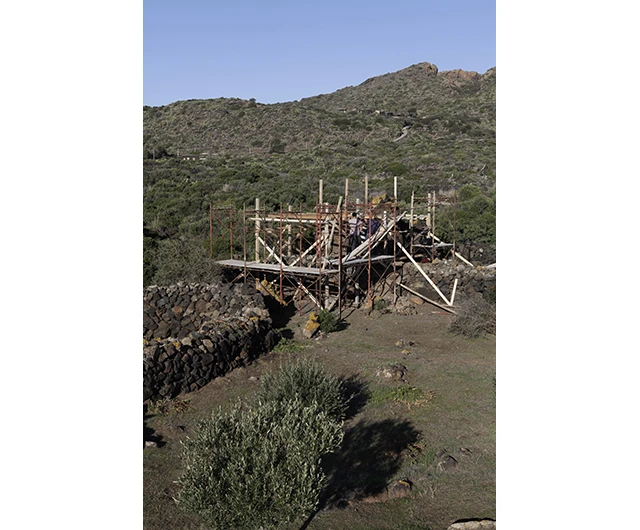
Between October and November 2014 the calculations and technical drawings for the construction of the platform, with the mushroom support and the props, were made by the engineer
Dirk Iserloh of the Ingenieurgruppe Iserloh Baustatik firm in Karlsruhe. Unlike the Indian system, the construction process also provided for the scaffolding, to be removed after
the concrete had set. All the trunks were to be installed only after the scaffolding was removed, so the slab had to be capable of supporting itself solely on the median pillar and
the spur of volcanic rock. To ensure the stability of the overhang over time, however, Iserloh provided for three trunks to be firmly anchored to foundation plinths of reinforced
concrete buried in the ground, in addition to the trunks simply inserted beneath the platform.
During his stays on Pantelleria, Födinger took pictures of anonymous houses and apartment blocks built of reinforced concrete and brick and left incomplete. They are similar in character
to Pierre Huyghe’s photographs of chantiers permanents, which document the reinforced concrete skeletons of unfinished houses in Southern Italy (Whiteread has also made a series of similar pictures).
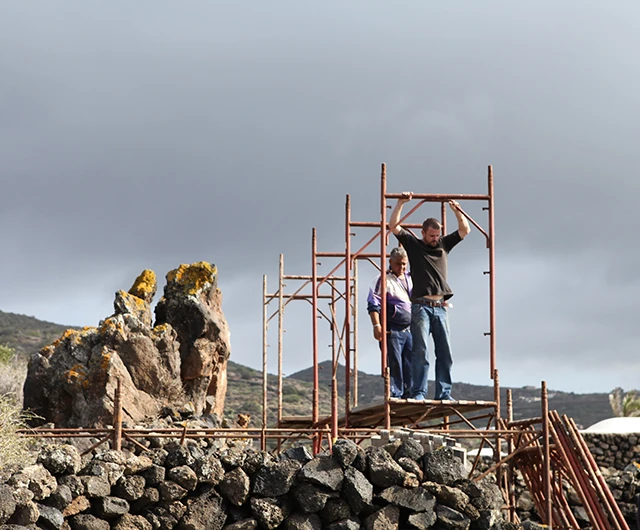
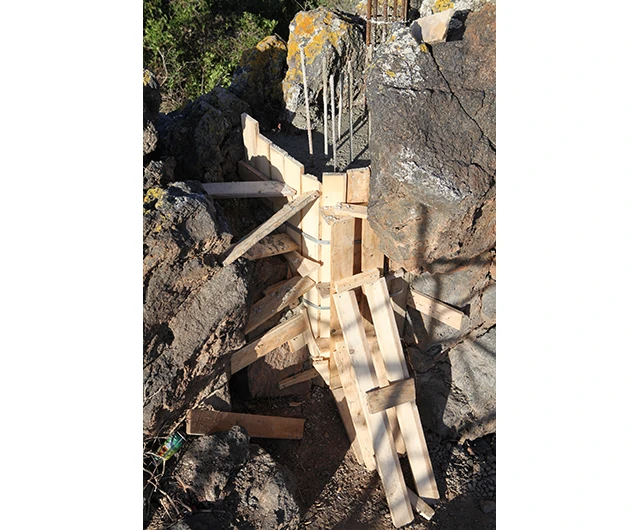
The small and rudimentary site for the construction of the platform was entrusted to the local builder Antonio Spata, assisted by a laborer and a carpenter. The scaffolding, along
with the metal trestles, planks, cement, rebars and concrete mixer, was carried by hand along the footpaths. The pillar designed by Iserloh became formless and was inserted into a
cavity in the rocks, which were carved with a jackhammer so that the reinforced concrete could be wedged in firmly, like the root of a tooth (the simile is Födinger’s).
Födinger’s photographic documentation of the various stages of the construction stops at the moment of the installation of the formwork for the pyramidal support, in 2015, as he had
to leave for Shanghai. By the time of his return to Pantelleria all the scaffolding had been dismantled and, against the advice of the engineer, the slab projected outward like a diving
board or one of Wright’s terraces, although that was not the desired effect. A photograph of Natalie Obert, Födinger’s partner at that time, pretending to dive from the springboard
fixes the transitory significance of the work in an image comparable to the one staged by Koolhaas with the architects who collaborated with him posed as bathing attendants around the
swimming pool of the Villa dall’Ava, ready to dive in and head for Paris along with that metaphorical floating swimming pool.
The cypress trunks, brought from Sicily, were inserted under the platform, commencing with the three to be anchored to concrete plinths. A heap of stones at their base masks the joint
and re-creates the effect of instability produced by the tree trunks in the photograph of the Indian building site, where they are set on piles of bricks. Wooden wedges were used to
stabilize the trunks against the platform. Födinger’s forest of natural and rudimentary supports contrast with the late-Flemish collection of columns in Memorial, conceived in 2015
by Filip Dujardin as a postmodern primordial temple.
The scaffolding for the slabs of Turiner Decke and Cantilever became a telluric construction in the Bint al-aryāh platform, which poses the question of the origin of architecture in
the act of sculpting; an act that must remain without any vital function apart from representing the idea and the sense of a shelter required by human beings. In Bint al-aryāh the idea
takes on such a violent material guise that it looks like a volcanic eruption and raises questions that lie at the root of European civilization: accommodating, protecting. Now it is
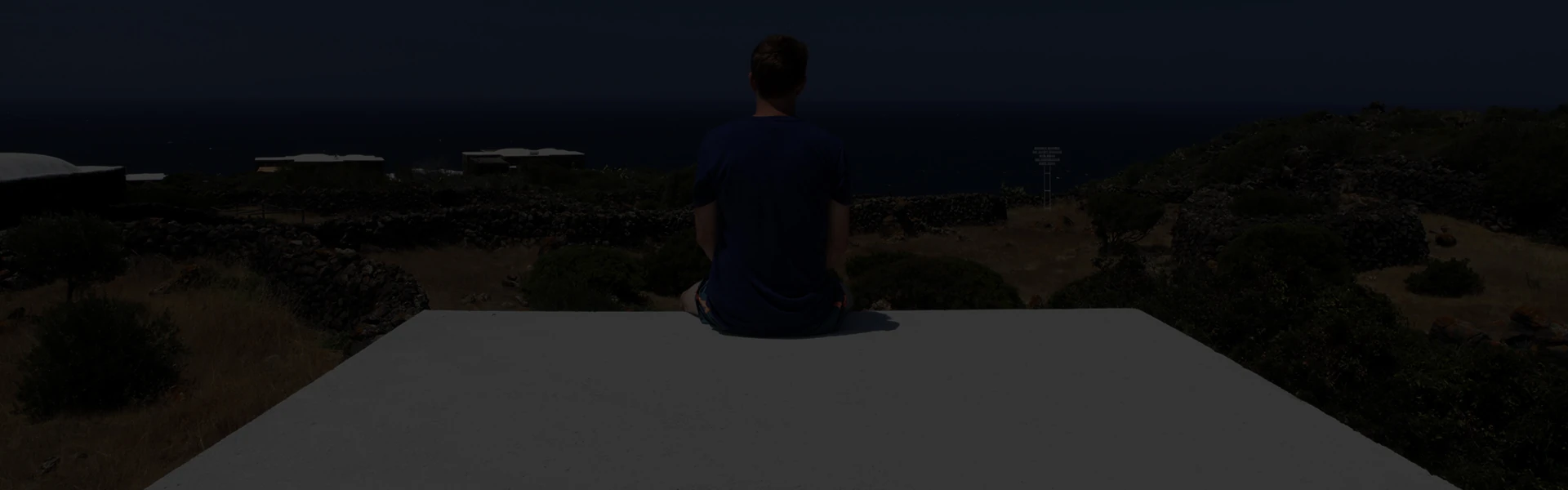
possible to climb onto Födinger’s platform, sit on the edge and contemplate the view of the Mediterranean, and even to make out, in particular atmospheric conditions, the coast of Tunisia,
but with a new awareness that that body of water has become the theater of a human tragedy.
The words Distance becomes the secret language with which the conversation takes place, raised on slender aluminum poles in Alice Guareschi’s sculpture of 2009, stand between Födinger’s
work and the sea, as if to illustrate the ultimate meaning of the platform.
And yet Bint al-aryāh wants to be an everlasting work, even though in the imminence of the tragedy it is able to convey in moderation the anguish that comes from the sea. For the belvedere
in the castle of Klein-Glienecke, erected to provide a view of the Romantic landscape of the park in the environs of Berlin, Karl Friedrich Schinkel made a copy of the Monument of Lysicrates
in Athens, ringed by 16 Corinthian columns, and called it the Große Neugierde (“Great Curiousness”), pursuing his aim of Hellenizing Berlin. Födinger no longer looks to Greek temples,
although his rudimentary construction cannot help but pose again the question raised by Vitruvius and Laugier on the origins of the art of building that led to such refined models.
In his belvedere, he has united the kind of primordial structure of the contemporary Indian building site with the archaic nature of the Sicilian landscape to provide a secluded place of contemplation and reflection—a refuge for the spirit.
The Latin definition de re aedificatoria, like the German Baukunst, seems to be more and more apt in explaining the nature of Födinger’s operations, and all the more so if we think that
Alberti, like Födinger, was obsessed with the fragility of structures eroded by time and subjected to human destruction, and that for this reason needed to be endowed with the greatest
strength and beauty in order to instill respect in barbarians.
But in light of the tragedy of the migrants landing on the coasts of the islands around Sicily, Bint al-aryāh takes on other meanings and is tinged with an intense humanity.
As usual Födinger has been able to keep this within the bounds of art, because his goal is to pass through the pain of living encountered in the present, so that the suffering and insecurity
of people’s existence enters the consciousness of individuals and reawakens their awareness of the human condition. It is not in the forms, but in the aspiration to the universal dimension of
feeling which the work of art is still capable of transmitting that the Hellenic spirit of Födinger’s belvedere lies. Viewed from the air the platform can also look like a glint of light.
A work realized while the belvedere on Pantelleria was still under construction alludes to other objects adrift in water. After the installation in Hamburg with the anchor and the buoy, the
theme of the balance between bodies pervaded by opposing forces was transformed into the representation of an anti-gravitational void, something that was presented by Födinger and Pieter Vermeersch
in the works they created for an exhibition at the Spazio Cabinet gallery in Milan from February 18 to April 3, 2015.
While Vermeersch evoked the concept by painting the walls in an ethereal shade
of blue, Födinger resorted to the mass and weight of a bundle of roughly squared wooden logs set on the floor alongside buckets filled with concrete tied to them with a rope. The trunks were similar
to the timber floating on water near Vancouver, seen in an aerial photograph on Flickr, to logs stacked at sawmills, and to an image of birch trunks on snow, felled and bound together with ropes,
all discovered through his exploration of the internet. The symbolic drifting of the bundle of trunks in the Spazio Cabinet gallery, like a raft carried along by the current, was halted
by the rope that anchored those trunks to the heavy buckets, makeshift containers of the sort used by farmers and builders, like the ones photographed Födinger in China, or like the ones created by Beuys and Hattan.
Anker or Ancora-Boa were the provisional titles used to classify the images of the work. But the official title, Neutral Buoyancy Lab, shifted the focus of the composition of the pieces onto the theme of floating in space,
for which that of floating in water was more than just a metaphor if we think of the special pool in the Neutral Buoyancy Laboratory (NBL) set up at the Johnson Space Center in Houston, Texas, to train astronauts to move
around in space in the absence of the force of gravity. Thus the works in Hamburg and Milan alluded to an environment where the force against which human structures have to react is lacking. Once again, as in the belvedere
on Pantelleria, Födinger suspended every sensation of a tragic contemporary drift in a measure so timeless that it had, here too, a Hellenic intensity.